What stands at the centre of my work is not the finished picture but the moment of its making: the point at which control gives way (mine or the sitter’s) and turns into a trace.
The starting point is an observation that kept repeating itself. Between what I intended and what I executed (stroke, colour), a disturbance appeared — a deviation I had neither planned nor could fully steer. At first I corrected it. Then I let it stand, later amplified it, and at some point it became the subject. The harsh colour of the early paintings is the record of that permission.
With that, my work shifted: I no longer compose the picture, I build the conditions it emerges from. Rules, settings, limits of time, physical demands (position, duration, freedom of movement) — arrangements that bring about the moment in which control fails. I do not plan the picture. It is the record of that moment.
The subject at its core is communication. Not language in the narrow sense, but its precondition: the implicit rules, the bodily reactions (tension, yielding, gesture), the unconscious and collective patterns. I examine which forms of non-verbal communication can serve as a constructive principle for finding an image.
Over the years I have joined this procedure to the classical pictorial means (measure, axes of movement, light and dark, proportion). Not as a return to order, but as a structure able to carry the disturbance that has meanwhile been established. I do not paint what is controlled. I paint the trace that appears when control gives way.
As the work went on, the disturbance grew quieter — or turned into symbol. What began as a slip became a language.

One procedure, across the whole body of work — each phase a variation on a single movement: letting conscious control give way, and recording the trace.
Daily Morning Me
Pastel · a morning protocol at the mirror
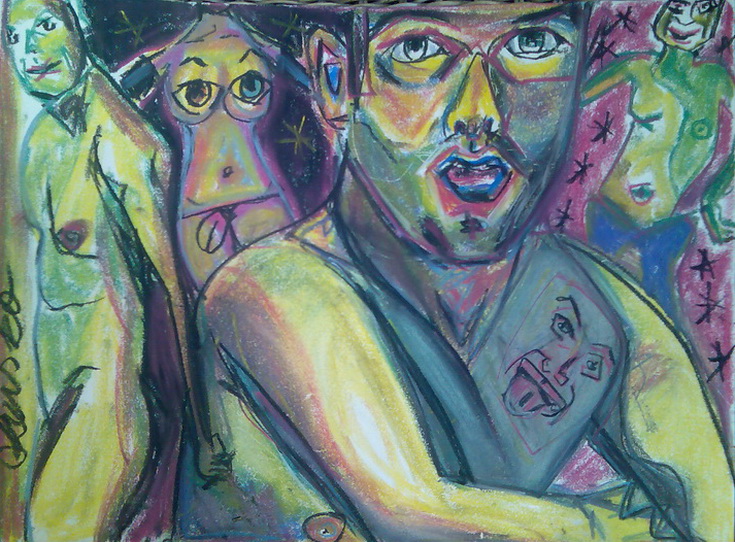
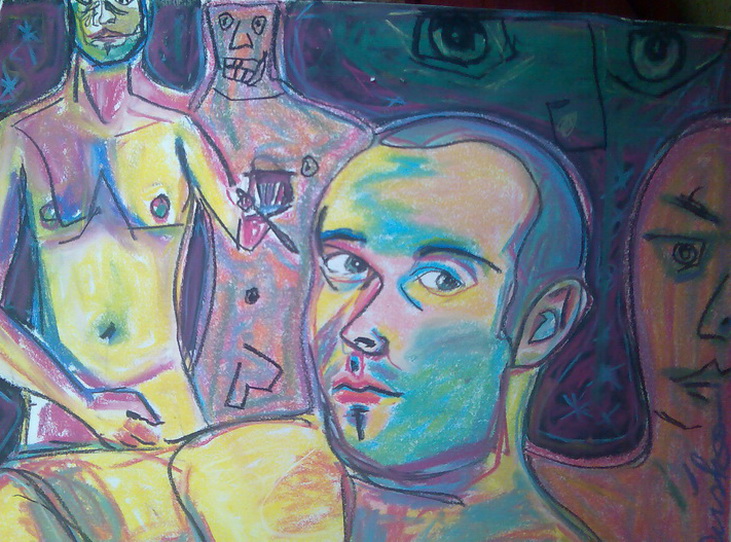
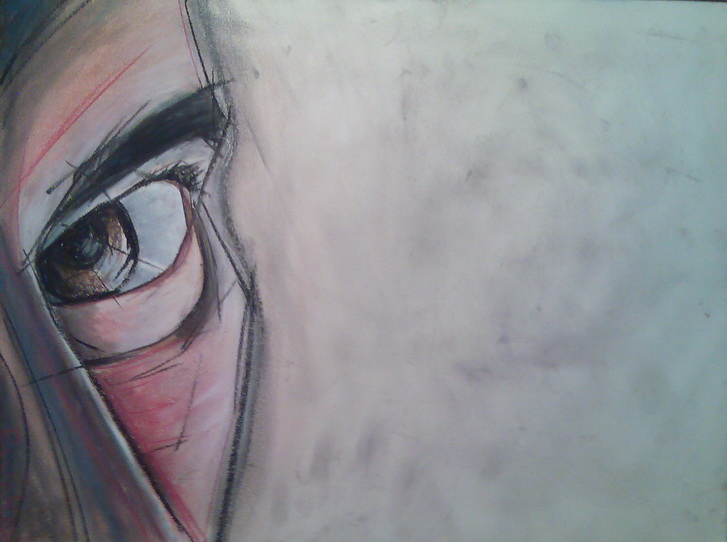
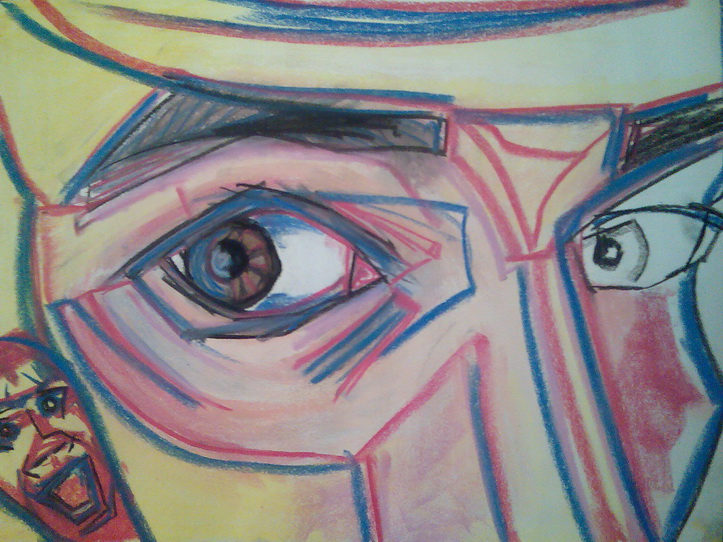
Every morning I sat in the kitchen at the mirror and set down whatever came up.
The aim was not to draw what I saw.
I drew unfiltered in pastel across some twenty to twenty-five sheets. Sometimes a mirror image came out, sometimes images that simply surfaced in my head and had nothing to do with the face in the mirror. Some in colour, some darker.
There was no decision about how the drawing should go. Across the series the likeness loosens and the form begins to give way — the first time I let that stand and did not correct it.
Selected sheets.
Portraits from the Model
Colour chosen in the moment
Painted directly from the sitter. The drawing holds the likeness; the colour does not.
What Freud called the parapraxis — the slip — appears here at the level of colour. The face is described, but the colour filling it was not chosen in advance and made no claim to reproduce nature. It arrived the way the disturbed stroke arrives.


Systemic Constellations
Three paintings, one procedure · The origin of the method
If a procedure can make a group or family system visible in space, then the same procedure must also be able to construct the collective signature of a historical or mythological event.
That was the original thesis: an attempt at a reversible method of picture construction. The arrangement was not directed. The sitters entered the room one after another, each finding her own place in the picture and taking the position she felt in that moment. The picture came about over several passes.
The constellation serves here to give relationship a place in space, not to make a therapeutic claim. It replaces the compositional apparatus.
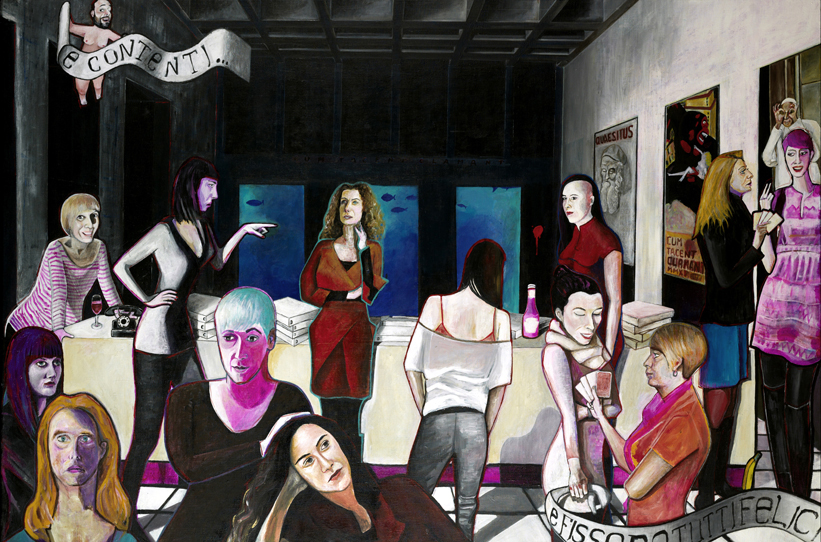
Systemisches AbendmahlAcrylic on linen · 180 × 120 cm · 2010Canonical compositionThirteen women. The roles were not assigned but drawn by lot. Each entered the room alone, knowing which role she had drawn, found her own place and held the pose she felt in that moment.
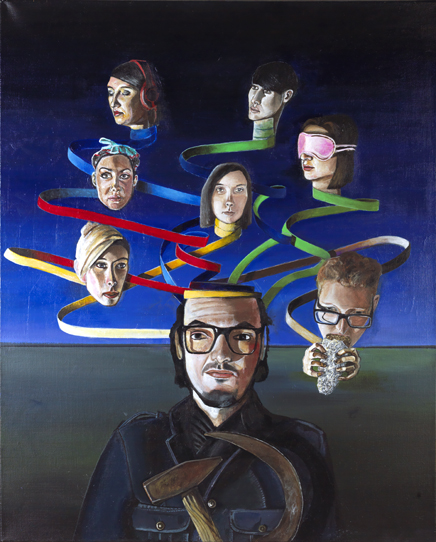
Medusa in der PauseAcrylic on canvas · 120 × 80 cm · 2011MythThe construct was made beforehand, the ribbons arranged intuitively. Everything else lay with the sitters: the positions, and how they interpreted the Medusa head, that is, the rendering of the heads themselves.

Eine Nacht am MeerAcrylic on canvas · 160 × 110 cm · 2012Attempt at a contemporary recordThe same procedure without lots. The positions were entirely open. The sitters came one after another and chose their position according to how they felt themselves within the picture.
Weibliche Abstraktion
Video installation · Series of paintings
An examination of the loss of autonomy — the point at which a person stops belonging to herself.
The work proceeds from Arno Gruen’s Der Verrat am Selbst. Die Angst vor Autonomie bei Mann und Frau (1984), which describes the surrender of the self as an adaptation learned early and defended for a lifetime.
Here too I build a condition. But I do not wait for a self-chosen position to give way; I set the restriction myself, the same for everyone, and record what the body does against it.
There was a template, the same for everyone taking part. The sitters sat on the table and placed their shoes, which they had chosen themselves beforehand, on this template. Every position of the feet was therefore identical, as a sign of unfreedom. The shoes were painted by the sitter.
The shoes were then filmed in a narrow frame fixed by a camera on a floor tripod. The feet were not allowed to move, holding on at the edge was permitted, the body was free to move. To produce any movement at all within the frame on the floor, the whole body had to strain. At the end of the filming each sitter was free to release the rigid pose however she wanted.
The videos run on old analogue television sets in a continuous loop, stacked in the same order as the tiles of the painted series.

VideoinstallationMagazin am Getreidemarkt · Installation view

Weibliche Abstraktion, Part IAcrylic on canvas

Weibliche Abstraktion, Part IIAcrylic on canvas
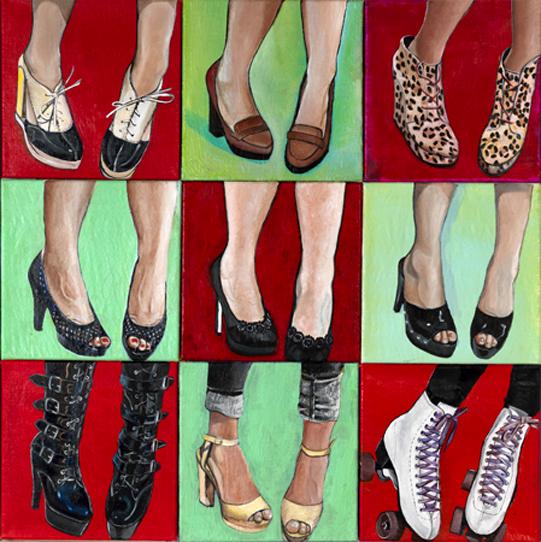
Weibliche Abstraktion, Part IIIAcrylic on canvas · 90 × 90 cm
Drawing Cycles
Duration-based drawing protocol · Studio, Linz
The sitter chooses the position. Not the painter.
Place, pose and form — clothed or nude — are chosen by the sitter. The final drawing is selected together.
What the protocol brings out is not a pose. It is what remains once a pose can no longer be sustained.
- 01The sitter chooses a pose she can hold for as long as possible. That is the only instruction.
- 02Despite this instruction, almost every sitter chooses a pose that begins to hurt within a short time. Duration was asked for; presentation is chosen.
- 03The position is held. The tension that follows is neither released nor staged. It accumulates.
- 04The sitter notes where the pain or the strain sits, and looks for a considerably more comfortable pose for the next round. Pain and strain set its direction.
- 05Several sheets document the disappearance of self-presentation.
- 06After the sitting the sketches are discussed together. One is selected and painted.
In a position held past its limit, the hands fail first. They register the tension before it shows in the face.
I show all four drawings and leave none out, not even the weakest sheet — usually it is the one on which the composed position collapses.

Sheet 1Chosen position, unheld

Sheet 2First compensation

Sheet 3Second compensation

Sheet 4Presentation gone
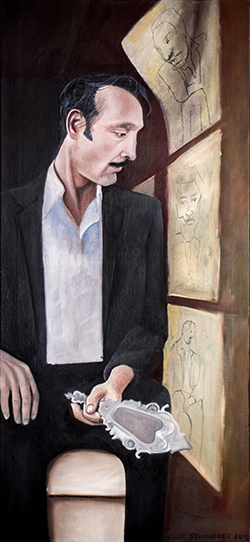
I do not improve the drawing in the painting. I enlarge the moment it recorded.
The same protocol, a different sitter. Here too I show all four drawings, in order and without omission, so that the two cycles can be read row against row.

Sheet 1Chosen position, unheld

Sheet 2First compensation

Sheet 3Second compensation

Sheet 4Presentation gone

I do not improve the drawing in the painting. I enlarge the moment it recorded.
Reading the Picture
Studies after the old masters · 2018 – 2021
Every picture I chose to study also chose something in me. The selection was never neutral. Each study also marked a change in me that I could not yet name.
In those years I studied the old masters, not to copy them but to read them. At the beginning I sat for hours in front of a picture and did not know where to start. In doing so I noticed the recurring measure: the smallest common unit on which the whole composition rests and which can be tested against the square. With it run the axes of movement, the lines along which the eye is led.
For a decade and a half I had not consciously worked with classical tools of construction. In studying the masters they entered, not because I had sought them out but because they lay in the pictures I was examining: the measure, the axis of movement, the golden section, tenebroso and chiaroscuro, the format, proportion-driven design. Afterwards I did not build to a scheme; I set these tools into the methods that had grown out of the non-verbal part of the work.
A second thing became clear more slowly. Which pictures drew me and how I read them shifted as I shifted. The choice was a kind of self-portrait: what I selected for study told me where I stood, just as years later the position a sitter chooses tells me where she stands.
Every picture has a rhythm. The studies were therefore not made for one-to-one reproduction; they come closest to a score: a sheet in search of the melody, of the notes behind the colour.
Four studies from those years. Each reads a canonical composition for the measure and the movement on which it is built.
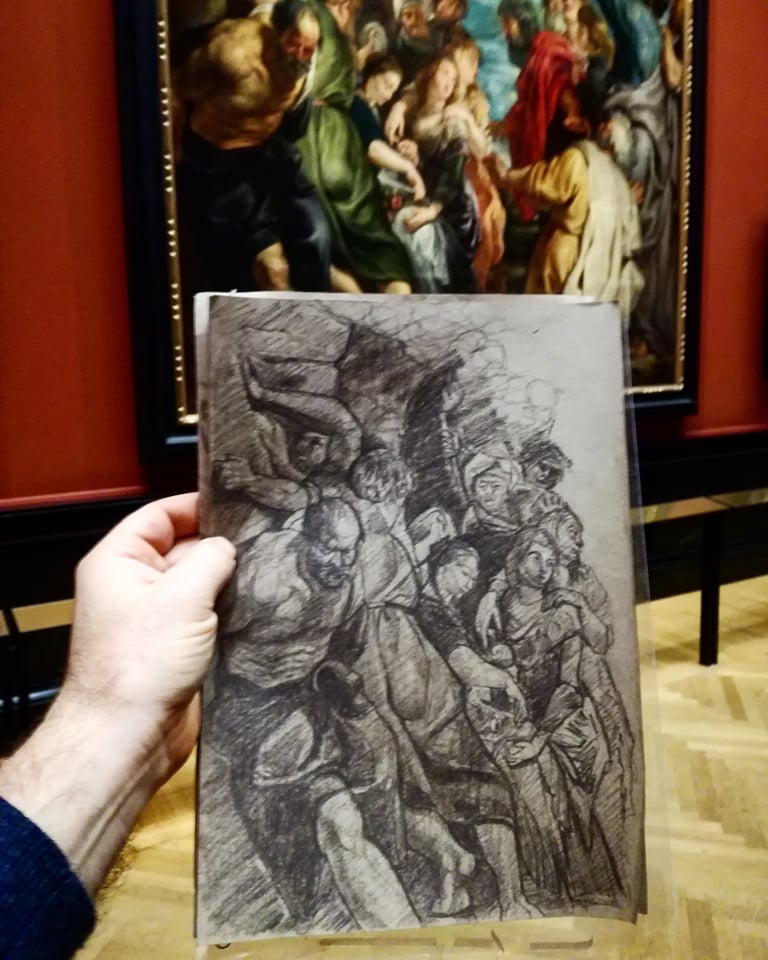
After RubensThe Assumption of the Virgin · c. 1611–14
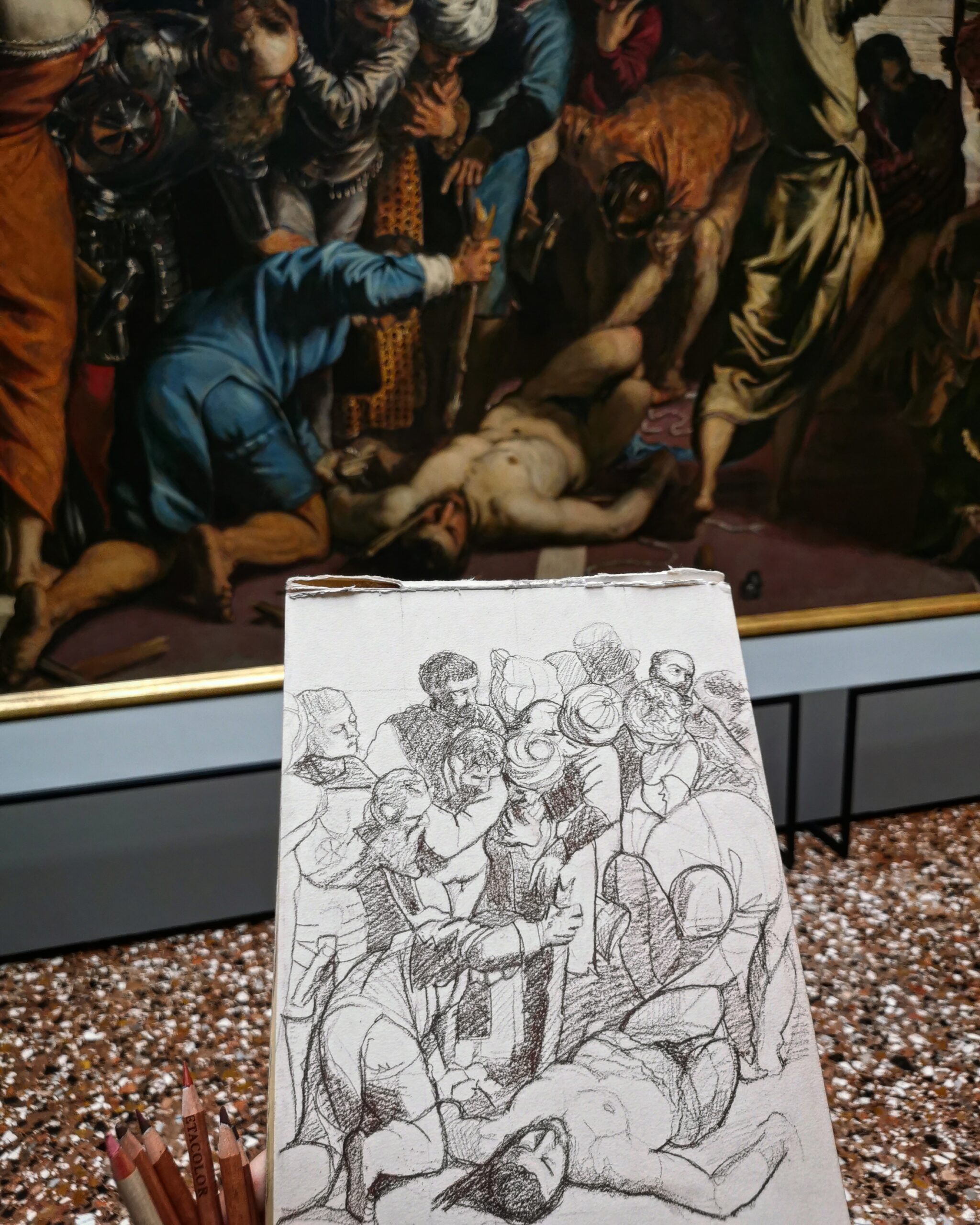
After TintorettoThe Miracle of the Slave · 1547–48
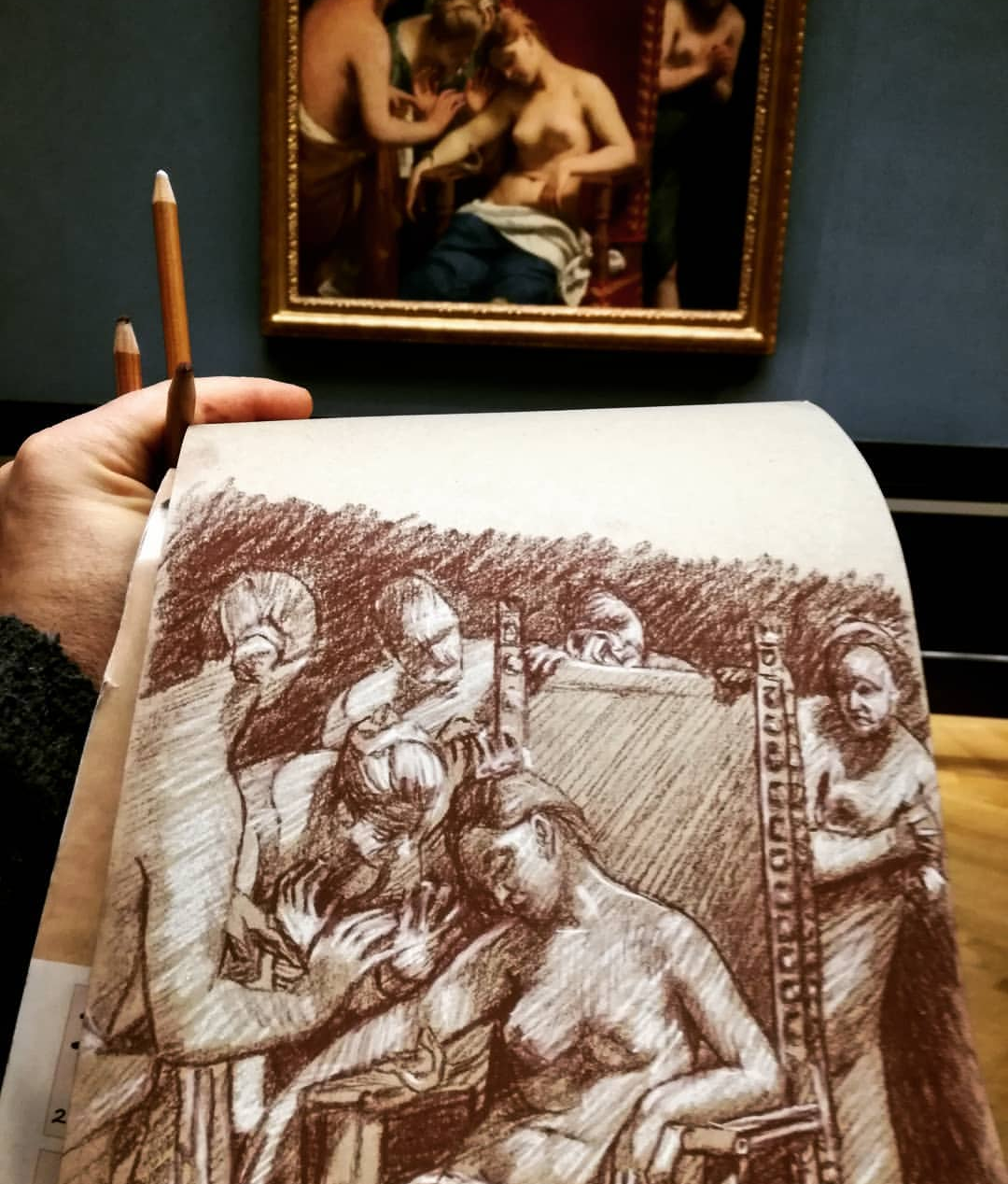
After CagnacciThe Dying Cleopatra
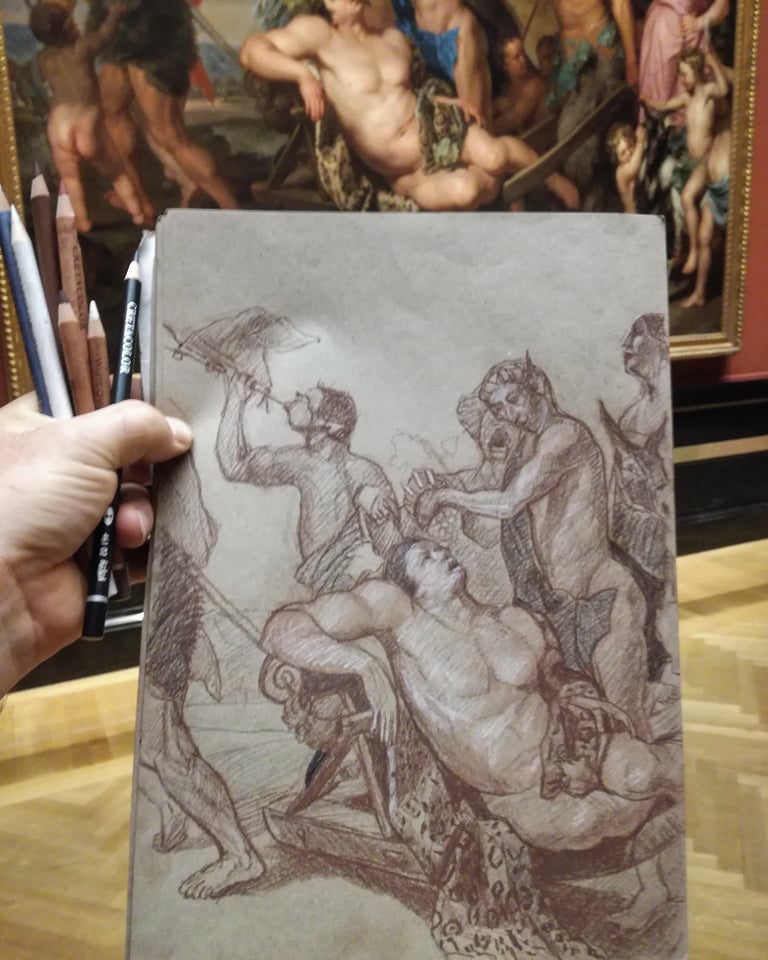
After WautierThe Triumph of Bacchus · c. 1650–59
Hands
Drinking Hands · Talking Hands · Gesture as involuntary speech
The hand says more than the voice.
Since 2020 the work has narrowed to the hands. They were the place where the trace appears first. In the drawing cycles the hands fail before the face gives way. This cycle takes them as the whole subject.
Drinking Hands and Talking Hands open it: the gesture treated not as illustration but as speech. One cannot not communicate, and Watzlawick’s axiom holds for the resting hand as well. When no word is spoken, it goes on speaking.
Studying the old masters left behind a question the cycle keeps open. Is the gesturing hand in a baroque composition a device of construction, a way of steering the eye and binding the figures to one another? Is it a cultural particularity? Or both at once? The cycle does not decide. It puts the question to every hand it draws.
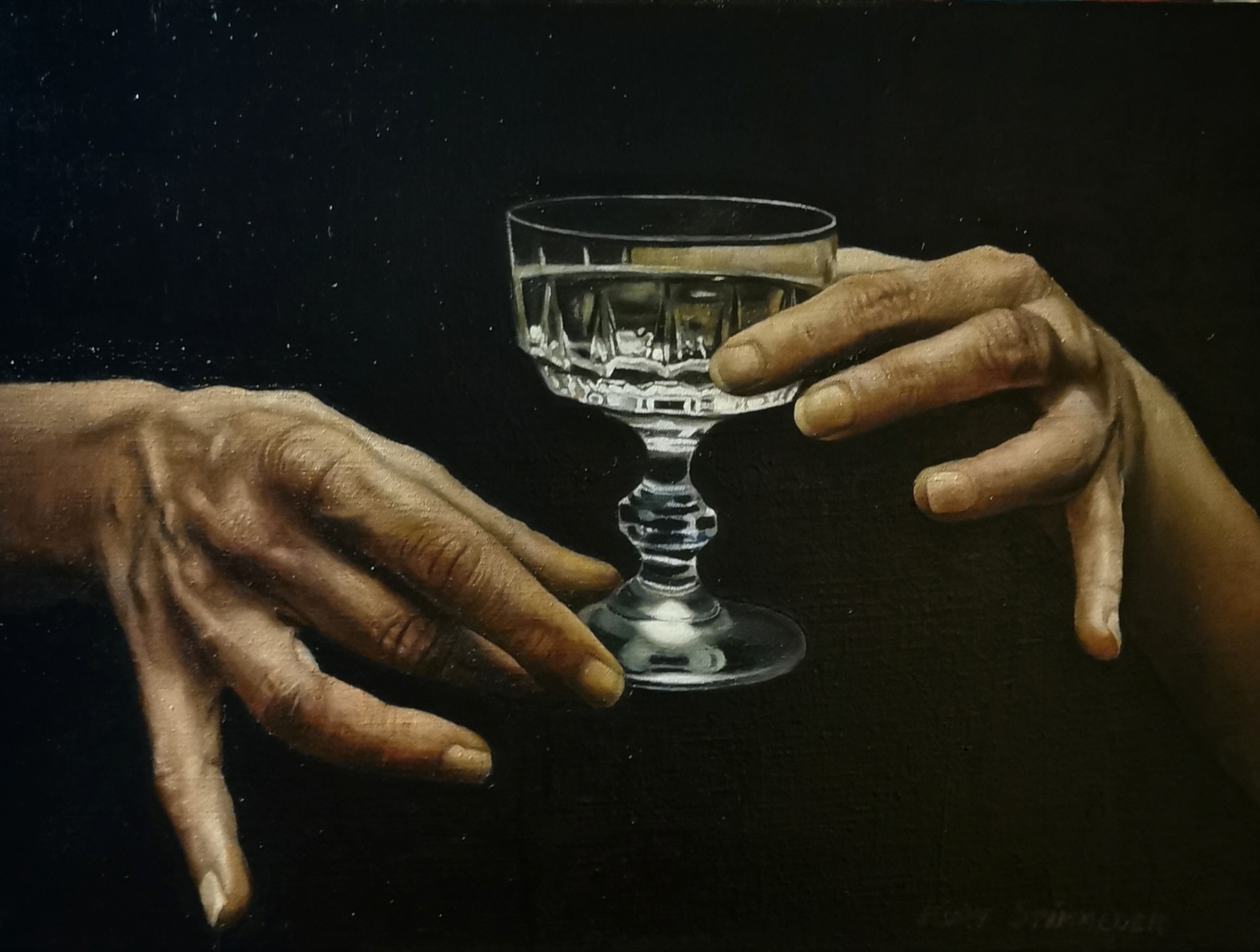
Drinking Hands2020
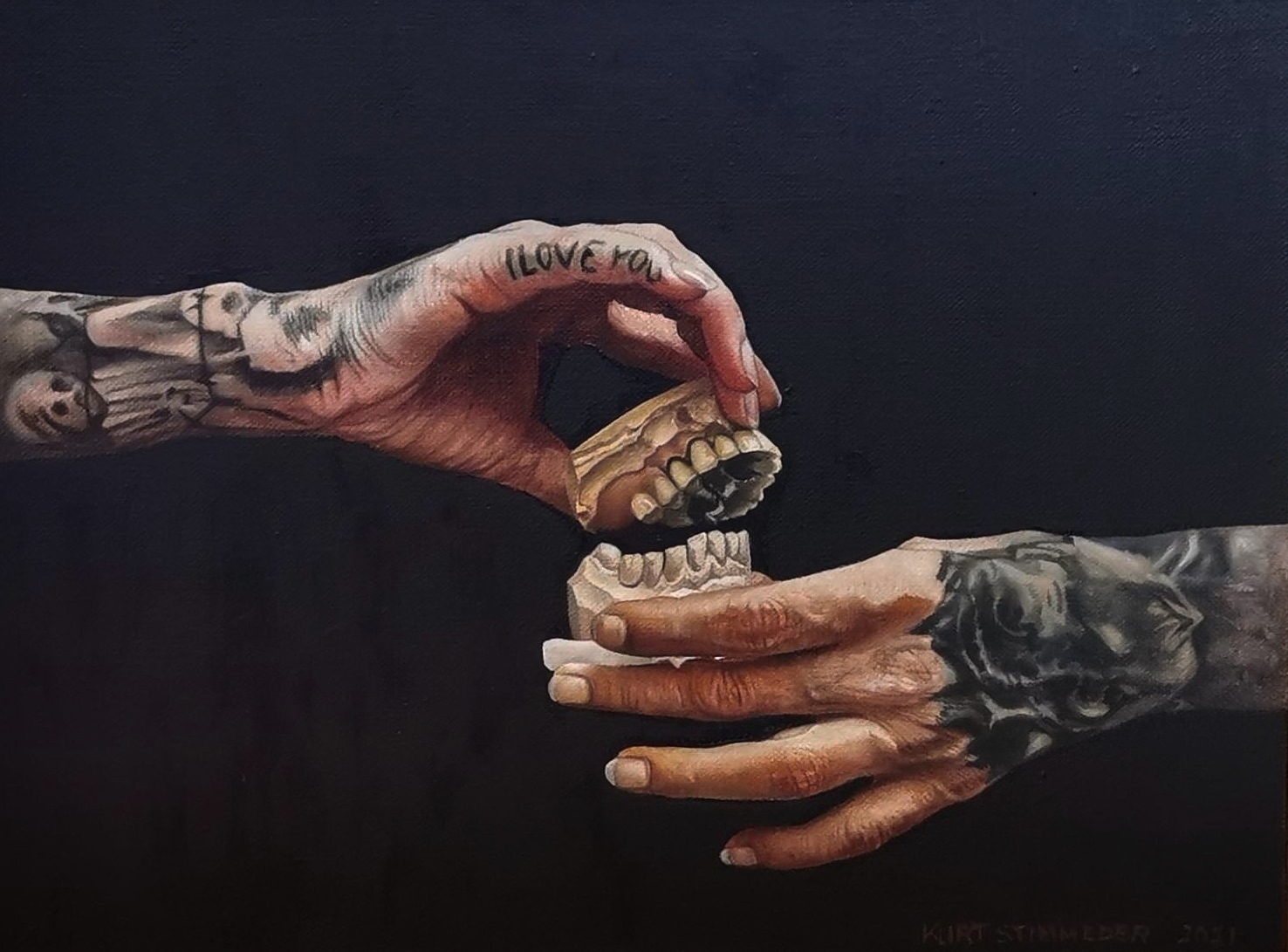
Talking Hands2021

The Big AppleFrom a series of four paintings · 2023
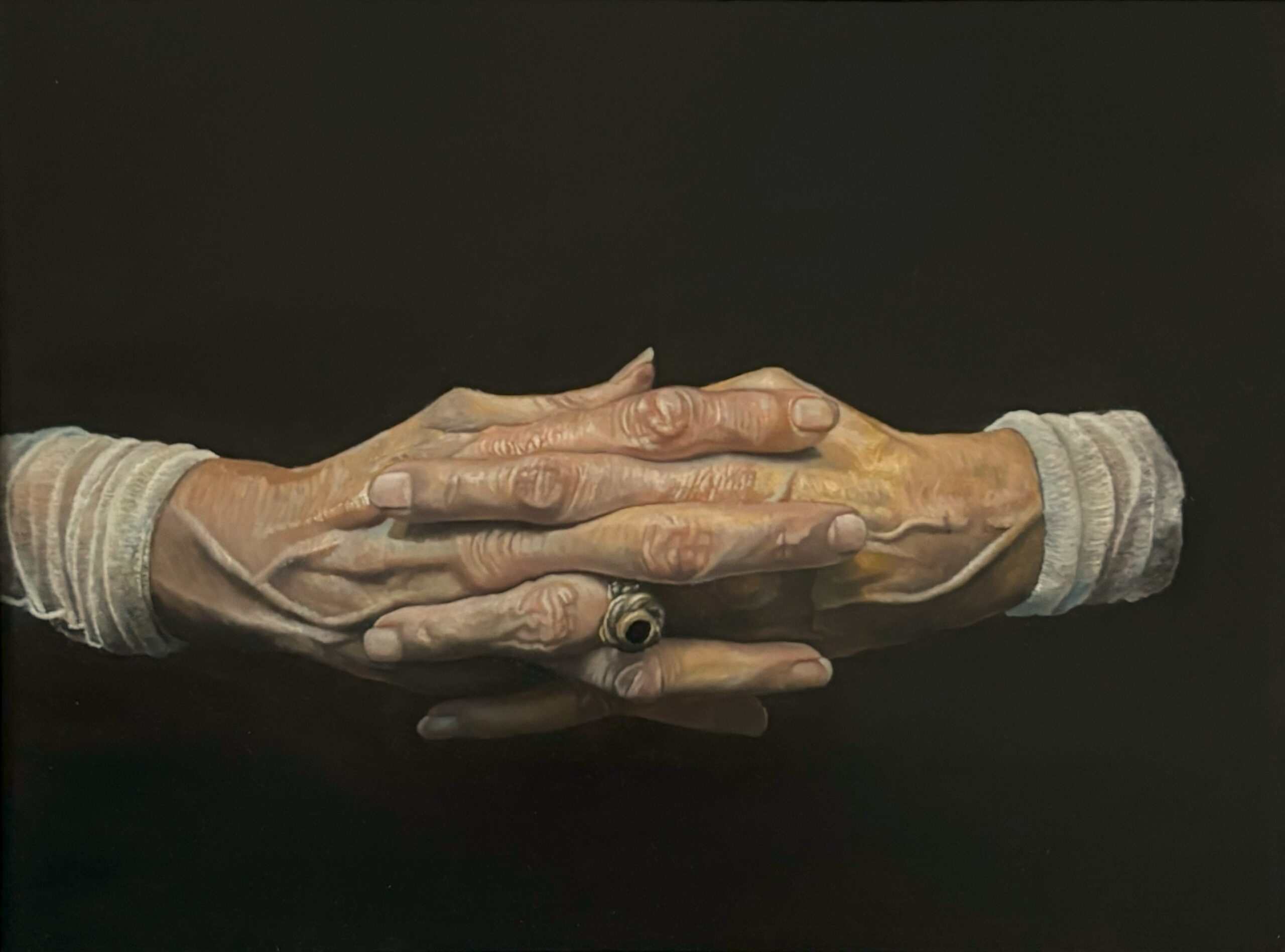
Folded Hands2025
Behind the Pose
The instant the pose falls · Oil on canvas
The moment the pose gives way, or just after.
Out of the observations made in the drawing cycles, attention moved from the pose to the tipping point, that is, to the moment it is given up. The way there again ran through several steps, which this time were not held down in sketches.
The tipping point does not last long enough to be drawn. Where the drawing cycles work with duration, this series works with a fraction of it, and for that the hand is too slow. Hence photography and video. Afterwards I select from the recordings the position that came closest to the tipping point. That is the same act as selecting a sheet after a sitting.
Photograph and video are sketch material and nothing else. They cannot be taken over one to one, or the distortion of the lens writes itself into the painting.
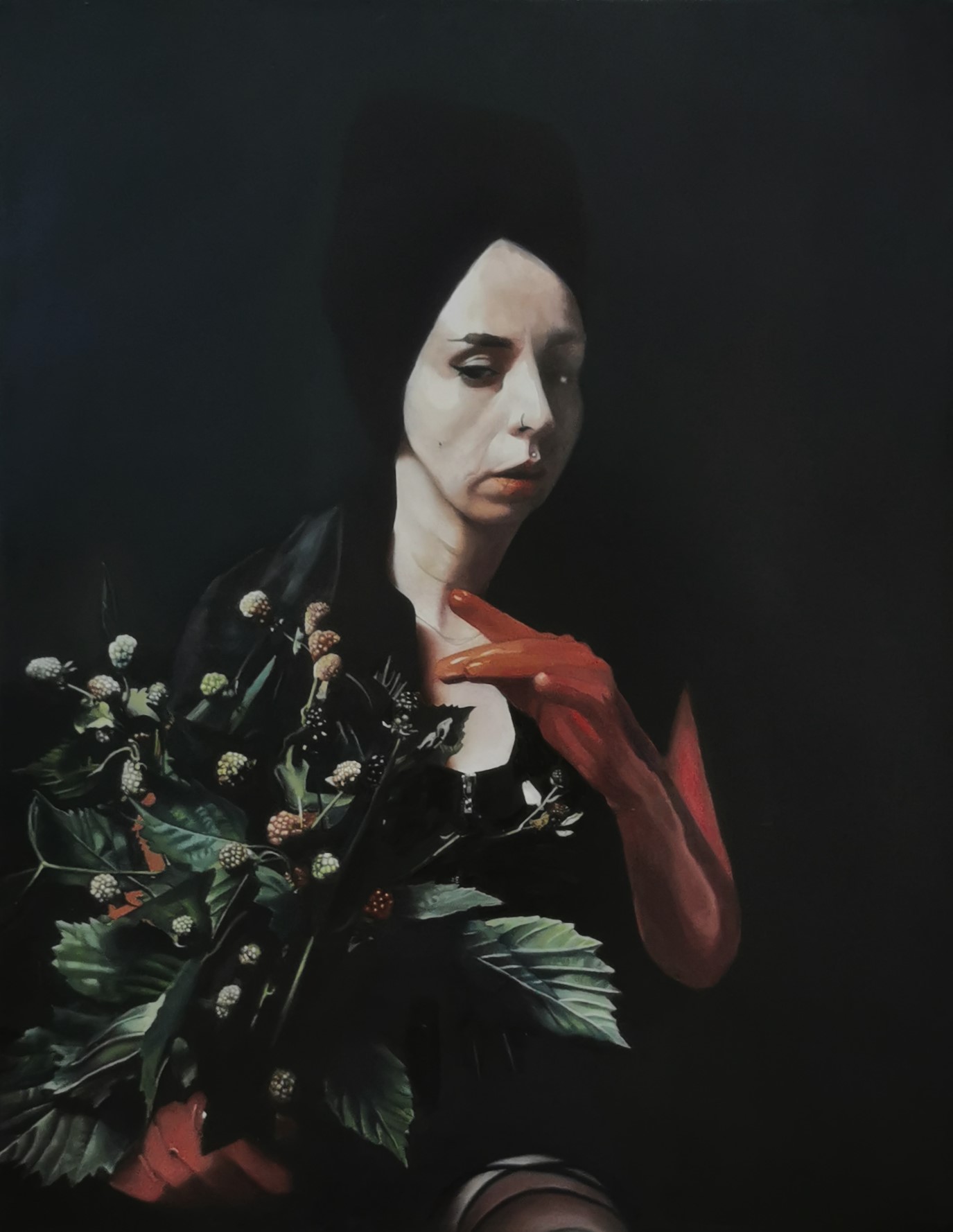
Girl with BlackberriesOil on canvas · 2024
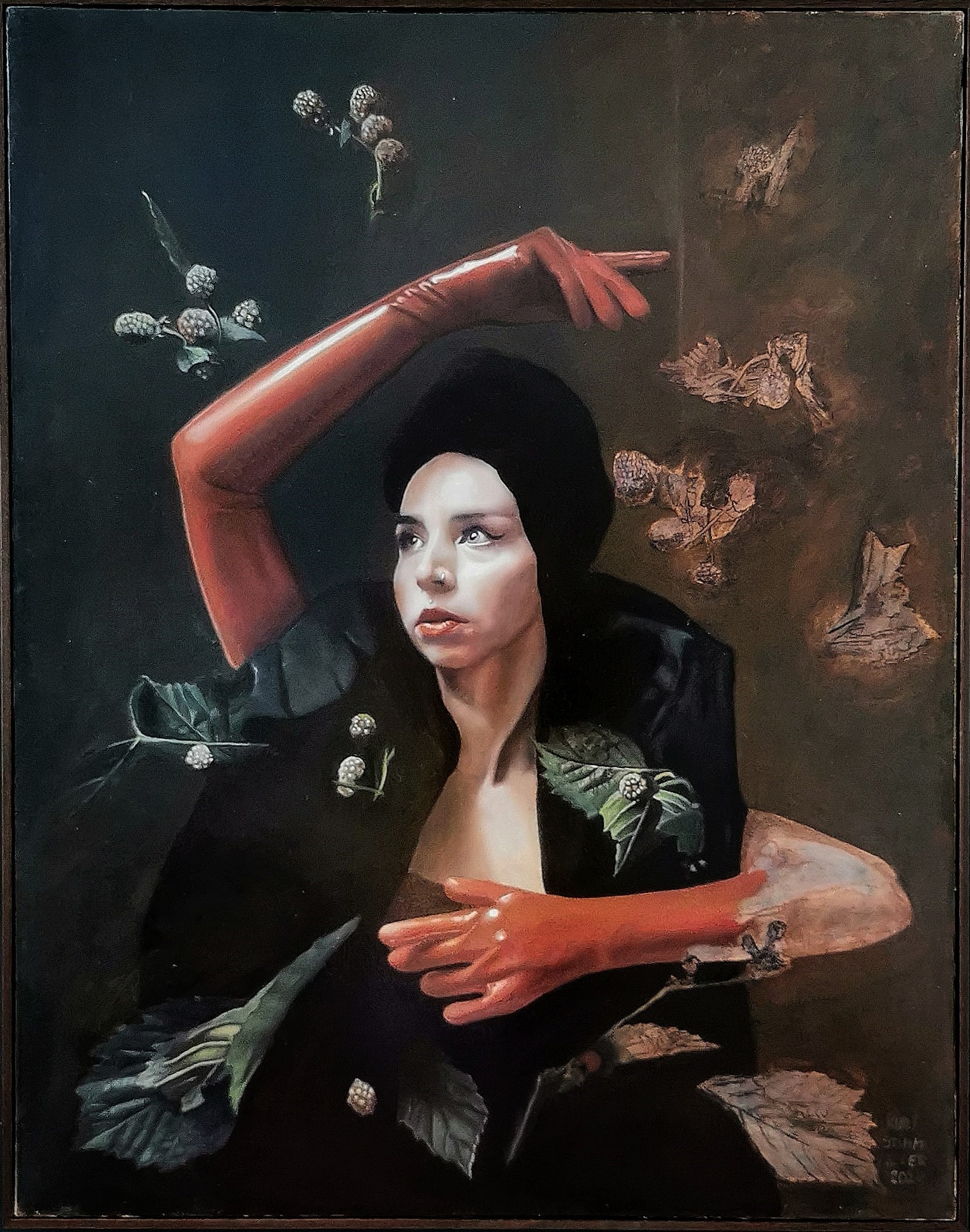
EpagogeOil on canvas · 2024
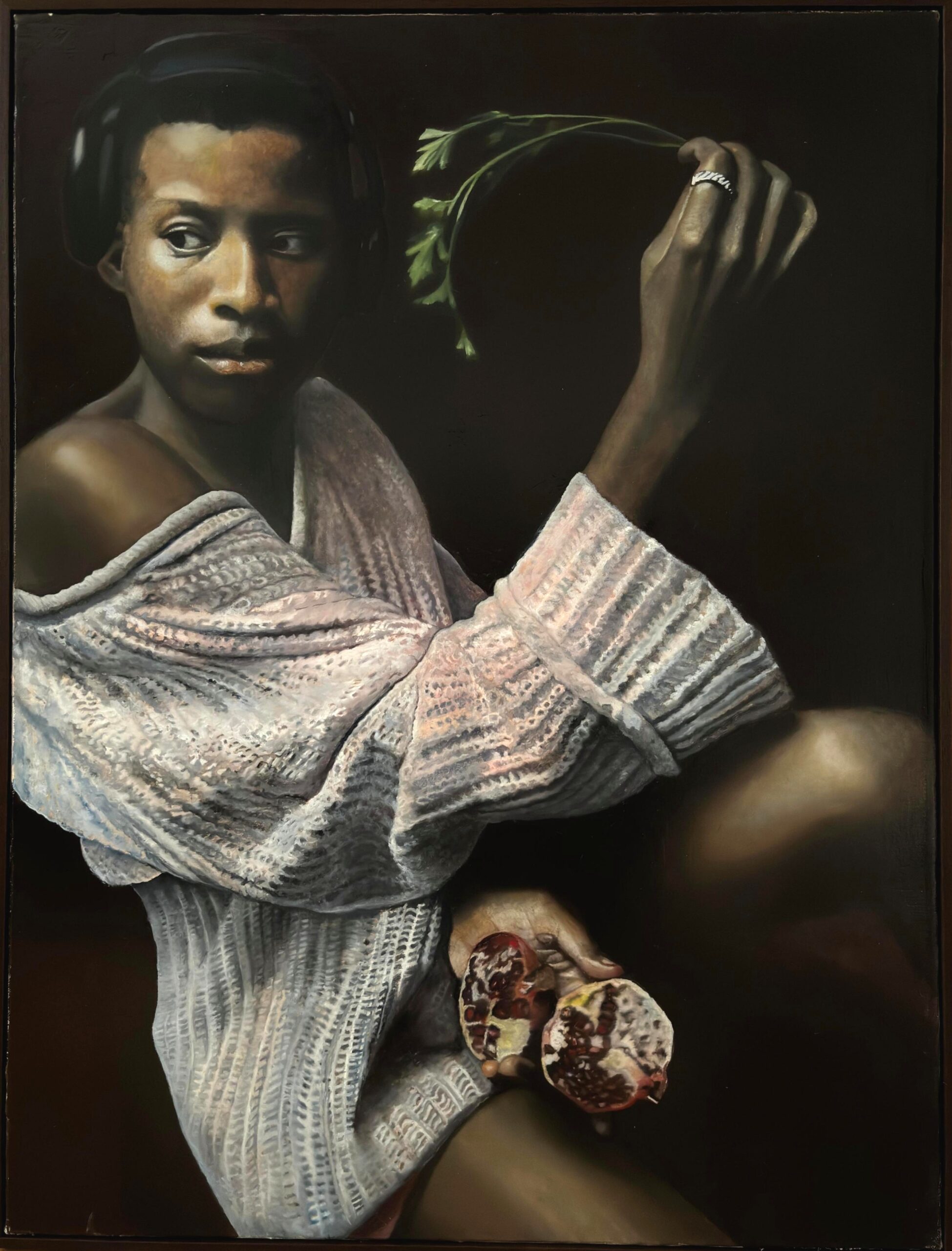
TrinityOil on canvas · 2024

The Green TroutOil on canvas · 2025
The Feast
Reading becomes making · with Caravaggio, Van Dyck, Delacroix
Here the old masters are no longer studied; they are deformed.
Three portraits with Caravaggio, Van Dyck and Delacroix, turned towards us, mouths open, not as a formal decision but as a bodily necessity. The hands press forward, the faces are distorted. I have brought the flesh into the foreground, set it in hard light and dark and wrapped it in the suggested turquoise of refuse sacks. Anger settles in the body, in the jaw, in tensions that wait there.
The joining of old painting to present-day elements follows no optical intention. The spirit of the present carries neo-romantic features: a phase of excessive rationality is followed by the turn inward. In the early nineteenth century it was disillusionment with the Enlightenment; today it is digital disembodiment. Where Caspar David Friedrich painted the wanderer before the fog, the person today stands before the horizon of his screens. The body becomes, in this, the last place of truth.
In Romanticism the idealised Middle Ages stood for the old, the transfigured better. The old-master influences in my paintings point to the same tendency in our own time. It may equally be that the epoch of Romanticism never ended and is a signature of modern society, one that can only be interrupted.
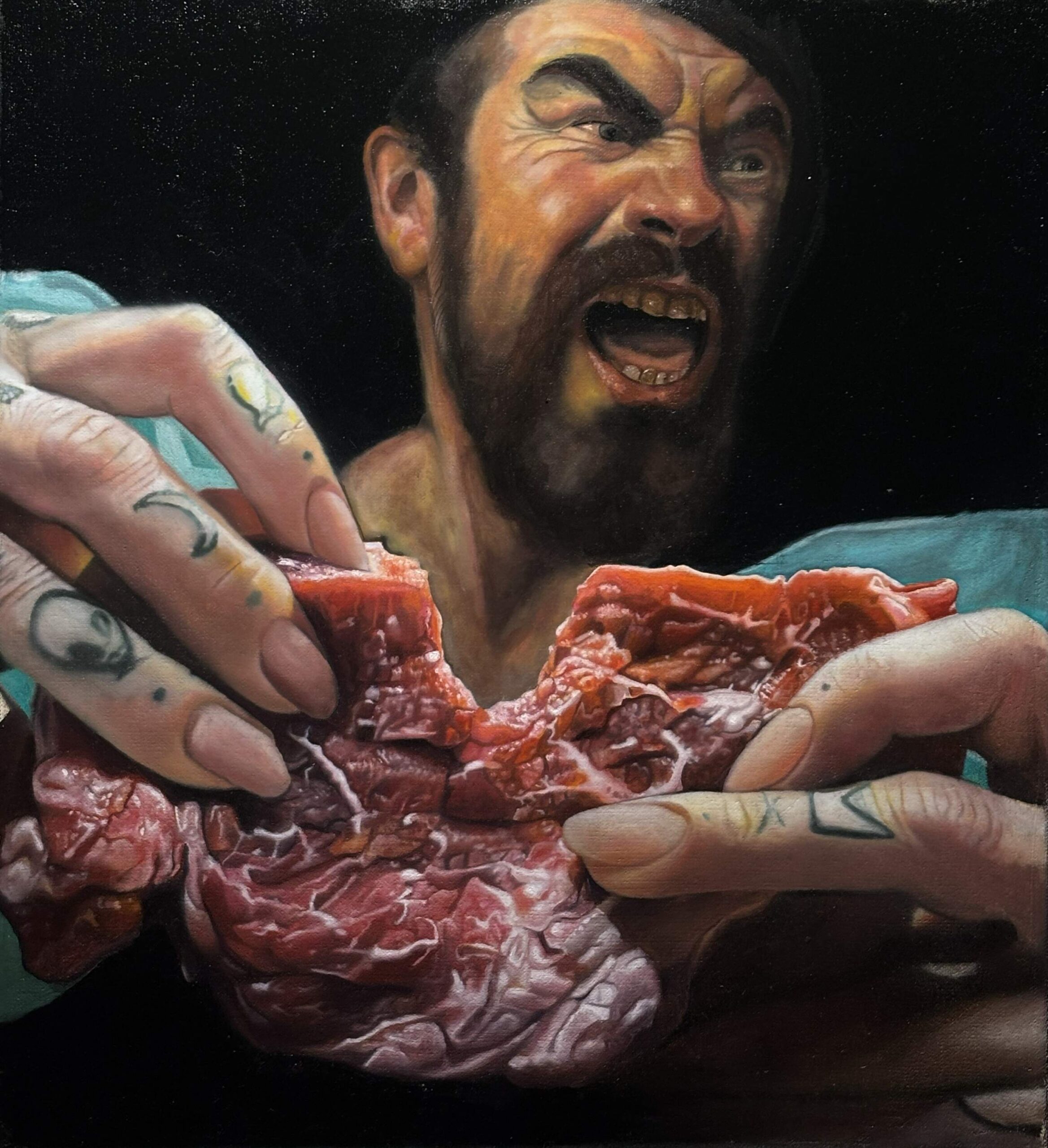 The Feast · I
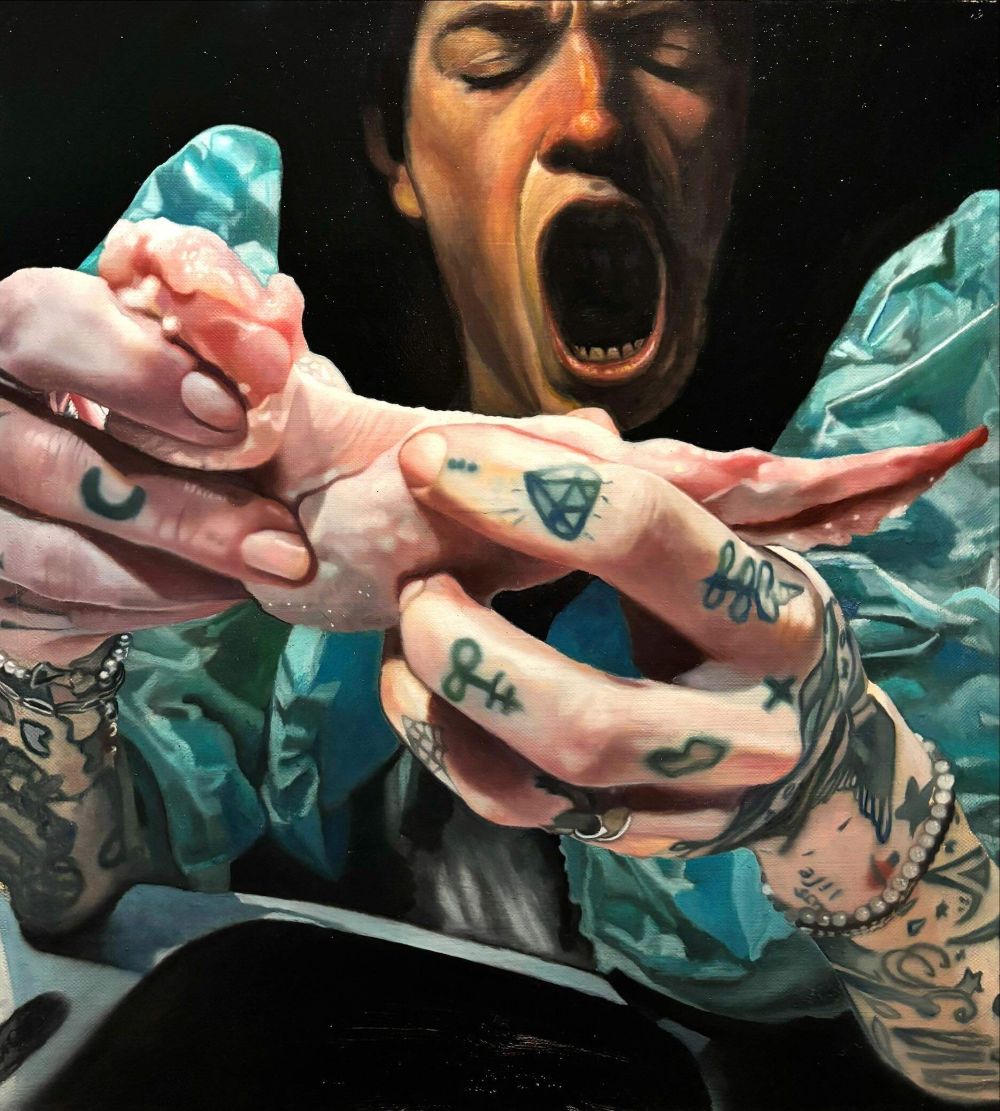 The Feast · II
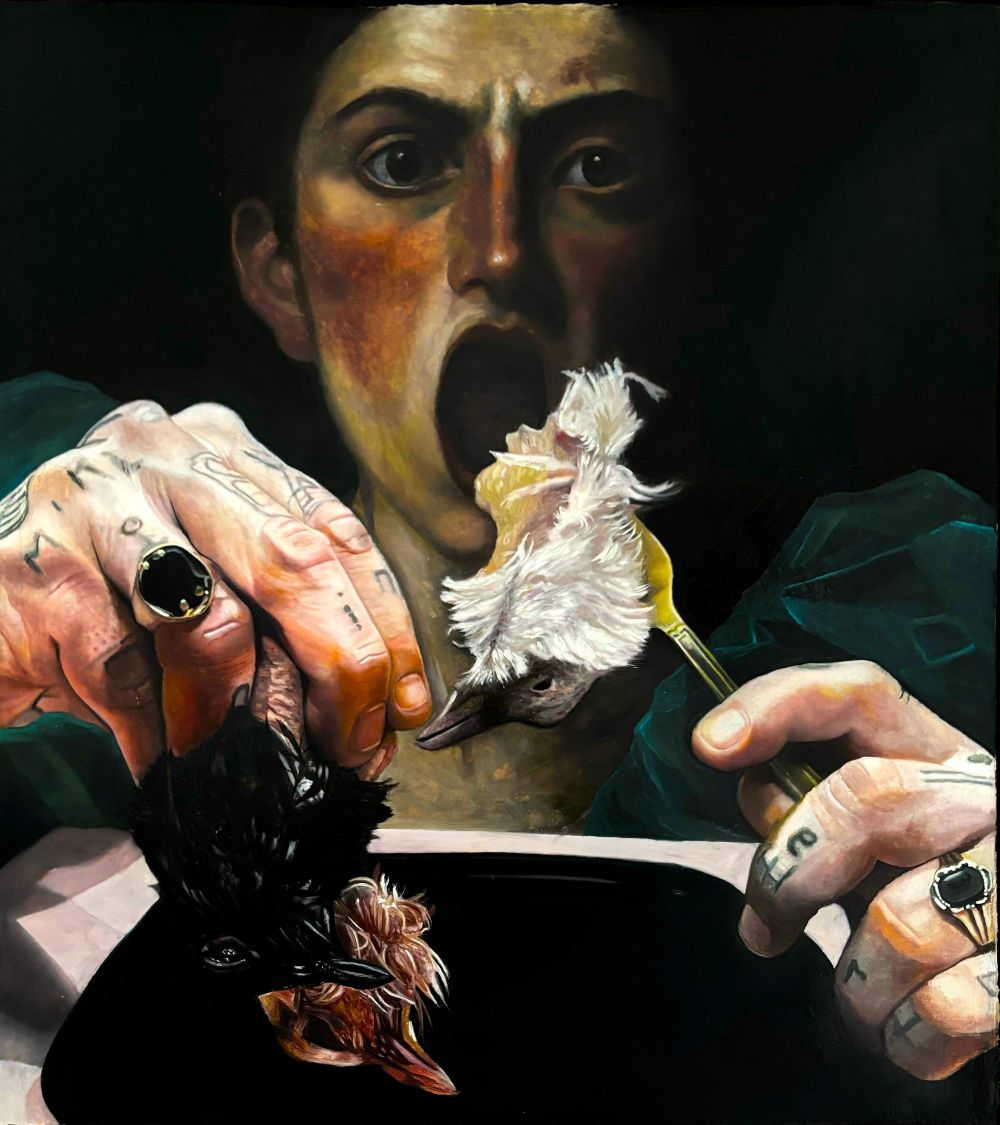 The Feast · III
What the body gives away cannot be renegotiated after the fact.